AMMAN, JO

4:44 PM

AMMAN, JO

4:44 PM

AMMAN, JO

4:44 PM

The System, Not the Citizen

The System, Not the Citizen

A strategic design exploration into cross-government service coordination

A strategic design exploration into cross-government service coordination

Strategic Design

2026

Jordan’s Sanad platform successfully unified digital access to government services, but the journeys behind those services remained fragmented across ministries, systems, and institutional boundaries. Citizens could authenticate seamlessly, yet still found themselves manually coordinating the state itself: navigating invisible dependencies, repeated verification, and disconnected service flows across government entities.

The issue was never access alone. It was coordination.

This project explores how strategic design can operate beyond interfaces and individual services, into the structural logic that shapes how public systems behave. Through systems mapping, journey analysis, and public-sector benchmarking, the work reframes Sanad not as a service owner, but as coordination infrastructure operating inside a highly constrained institutional environment.

The outcome was the Journey Definition Layer (JDL): a lightweight coordination framework designed to make cross-government journeys visible, operable, and structurally coherent without centralizing authority, redesigning ministry systems, or introducing new governance structures.

Keywords

Strategic Design

Innovation Consulting

Systems Thinking

Service Design

Platform Strategy

Public Sector Innovation

Digital Government

Journey Orchestration

The Trust Gateway

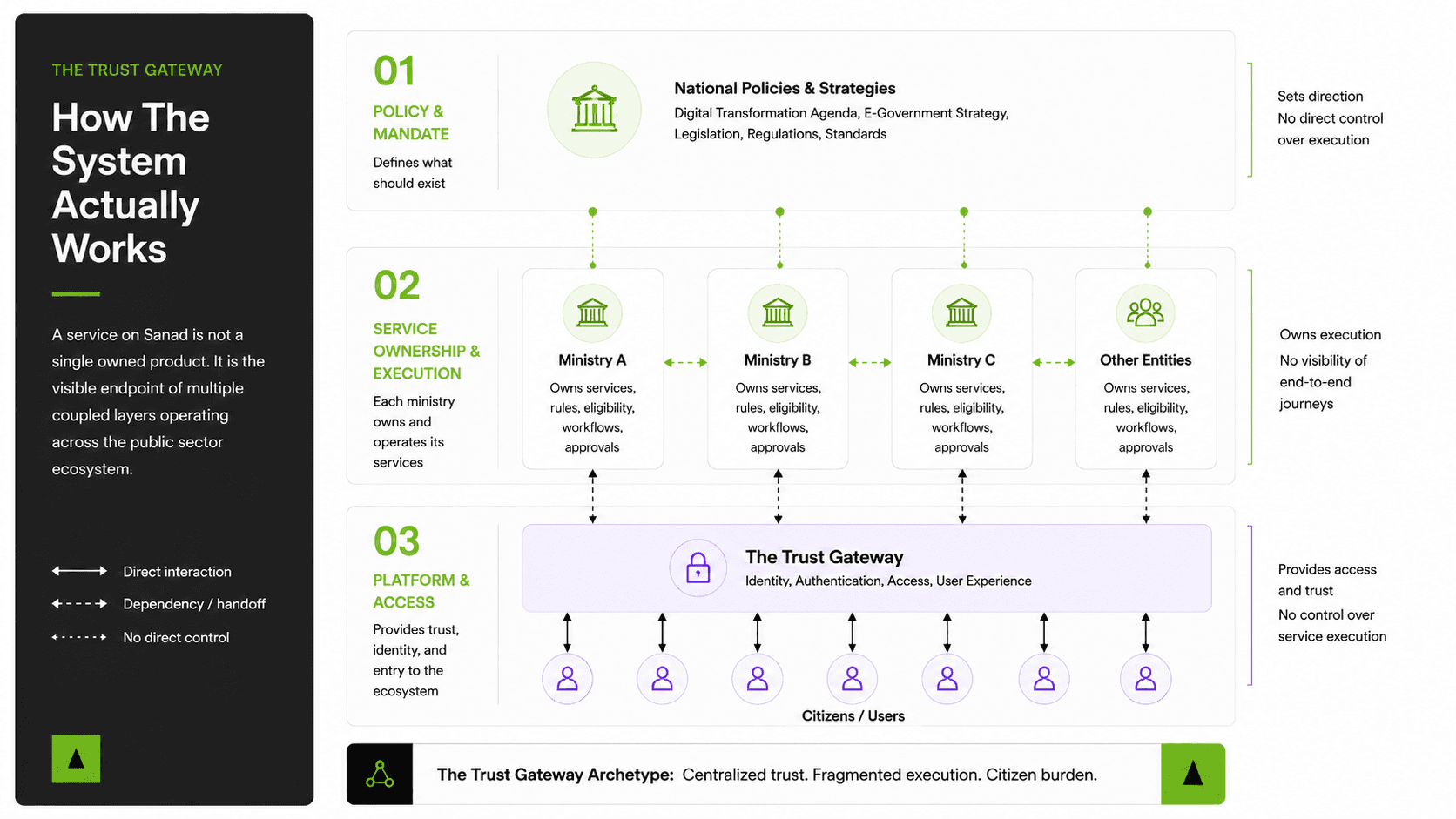
Jordan’s Sanad platform operates as a national trust gateway: a shared digital infrastructure that centralizes identity, authentication, and access to government services. But a “service on Sanad” is not a single owned product. It is the visible endpoint of multiple coupled layers operating simultaneously across the public sector ecosystem.

  • Layer 1 | Policy & Mandate: National modernization agendas and digital transformation strategies define what should exist across government services.

  • Layer 2 | Service Ownership & Execution: Individual ministries govern eligibility rules, workflows, approvals, exceptions, and operational delivery within their own systems.

  • Layer 3 | Platform & Access: Sanad mediates trust, identity, and entry into the ecosystem, creating the experience of one connected government interface.

This layered structure creates a critical disconnect. While citizens experience Sanad as a unified platform, the journeys behind that interface remain fragmented across independently governed systems with no shared ownership of the end-to-end outcome. Trust becomes centralized at the platform layer, while accountability, coordination, and execution remain distributed beneath it.

The project began by mapping these relationships and identifying Sanad’s underlying operating logic as the Trust Gateway Archetype: a system capable of scaling digital access and institutional trust across government, but not coordinating cross-ministry journeys on its own.

Exhibit A

Exhibit B

Structural Tensions & Leverage

As the platform scaled, the system began revealing a set of recurring structural tensions, not as isolated usability issues, but as predictable outcomes of how digital government coordination was organized.

  • Unified Access vs Fragmented Outcomes
    Citizens authenticated through a single trusted interface, yet still encountered disconnected service flows, repeated verification requirements, and invisible dependencies across ministries and institutions.

  • Trust Transfer vs Authority Boundaries
    Trust became centralized at the platform layer, while authority over approvals, eligibility, exceptions, and operational delivery remained fragmented across independently governed entities.

  • Perceived Accountability vs Institutional Ownership
    Because Sanad operated as the visible front door to government services, users increasingly associated success and failure with the platform itself, even when operational responsibility sat elsewhere in the system.

  • Platform Ambition vs Institutional Capacity
    As digital government ambitions expanded, coordination complexity increased faster than institutional capacity. Ministries remained operationally siloed, while no shared mechanism existed to define or manage end-to-end citizen journeys across the ecosystem.

Rather than treating these tensions as isolated service failures, the project reframed them as leverage opportunities inside the system itself. The exploration focused on three strategic intervention areas: journey orchestration to make cross-government pathways visible, platform expectations to influence coordination without authority, and learning loops capable of transforming repeated friction into system-level signals.

Together, these leverage areas shifted the focus of the project away from interface redesign and toward a larger question: how can a government platform coordinate journeys it does not own?

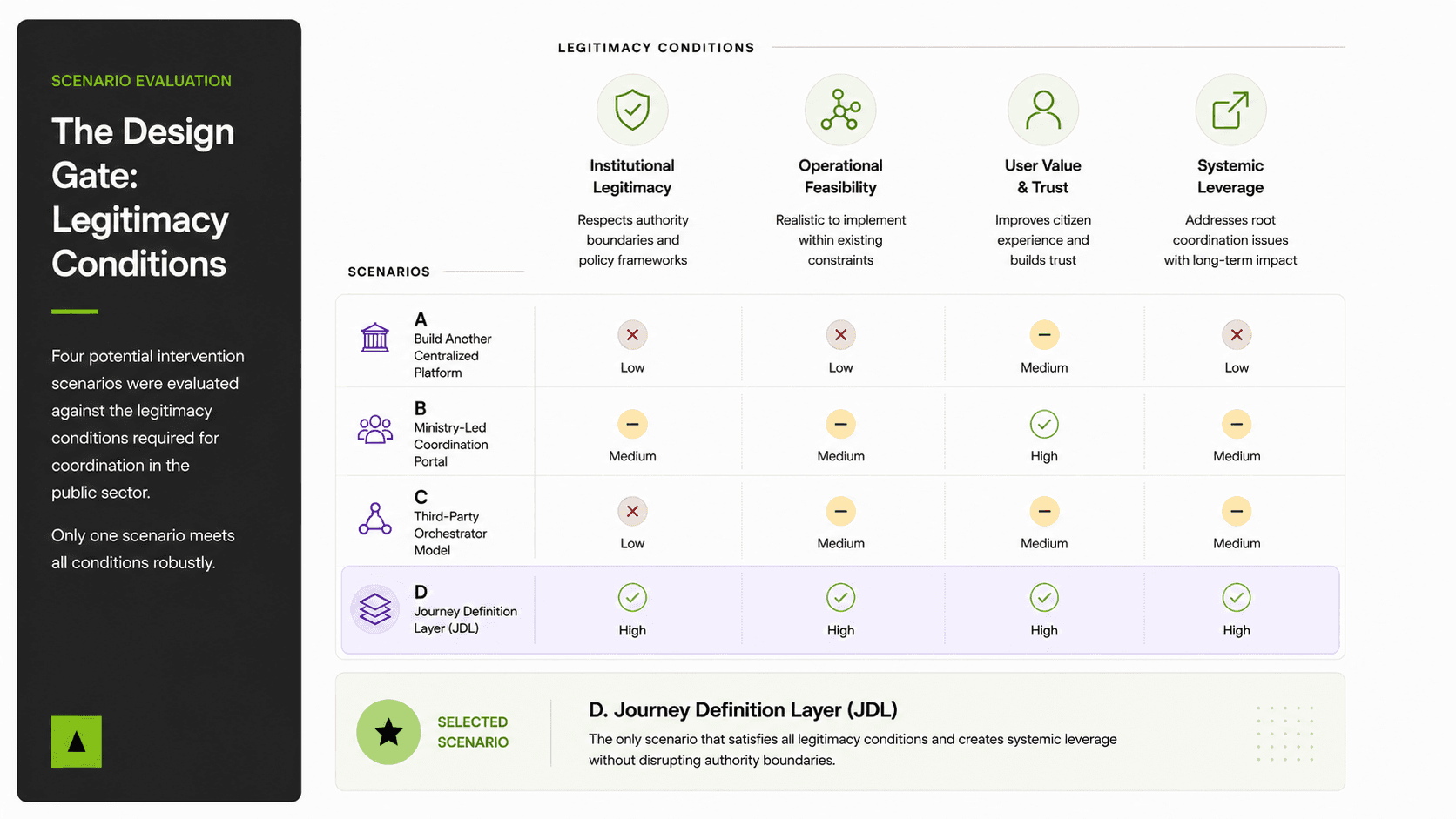
The Design Gate: Legitimacy Conditions

Before proposing any solution, the intervention space was deliberately constrained. These were not design preferences, but structural realities embedded within Jordan’s public-sector environment. Any intervention that failed even one of these conditions could not legitimately move into the solution space.

  • Financial Reality
    No new budgets. No procurement-heavy transformation.

  • Political Reality
    No governance reform. No authority redistribution.

  • Bureaucratic Reality
    No additional reporting. No operational friction.

  • Organizational Reality
    No permanent coordination teams. No reliance on sustained manual oversight.

These constraints fundamentally changed the direction of the project. Traditional coordination models, centralized orchestration, and workflow redesign approaches all became structurally non-viable within the context of Jordan’s institutional environment. The challenge was no longer how to redesign government services, but how coordination itself could emerge within these constraints through visibility, structure, and shared system logic rather than centralized control.

This led to a scenario evaluation process that tested multiple intervention paths against the realities of implementation. Visibility alone improved understanding but failed to influence system behavior. Full system learning introduced operational and political complexity before coordination maturity existed. Only one direction survived all constraints: coordinated influence through lightweight structural defaults.

The result was the Journey Definition Layer (JDL), a shared coordination layer embedded within the Sanad ecosystem. Rather than treating services as isolated transactions, the JDL organizes them into structured end-to-end journeys such as business registration, residency renewal, or property transfer.

For each journey, the platform explicitly defines:

  • the intended outcome

  • participating entities

  • service dependencies

  • ownership boundaries

  • completion conditions

  • and where digital or physical interactions occur

This allows the platform to understand not just whether a citizen can access a service, but what journey they are actually trying to complete, what that journey depends on, and where coordination breakdowns are likely to emerge across the system.

Structural Tensions & Leverage

As the platform scaled, the system began revealing a set of recurring structural tensions, not as isolated usability issues, but as predictable outcomes of how digital government coordination was organized.

  • Unified Access vs Fragmented Outcomes
    Citizens authenticated through a single trusted interface, yet still encountered disconnected service flows, repeated verification requirements, and invisible dependencies across ministries and institutions.

  • Trust Transfer vs Authority Boundaries
    Trust became centralized at the platform layer, while authority over approvals, eligibility, exceptions, and operational delivery remained fragmented across independently governed entities.

  • Perceived Accountability vs Institutional Ownership
    Because Sanad operated as the visible front door to government services, users increasingly associated success and failure with the platform itself, even when operational responsibility sat elsewhere in the system.

  • Platform Ambition vs Institutional Capacity
    As digital government ambitions expanded, coordination complexity increased faster than institutional capacity. Ministries remained operationally siloed, while no shared mechanism existed to define or manage end-to-end citizen journeys across the ecosystem.

Rather than treating these tensions as isolated service failures, the project reframed them as leverage opportunities inside the system itself. The exploration focused on three strategic intervention areas: journey orchestration to make cross-government pathways visible, platform expectations to influence coordination without authority, and learning loops capable of transforming repeated friction into system-level signals.

Together, these leverage areas shifted the focus of the project away from interface redesign and toward a larger question: how can a government platform coordinate journeys it does not own?

Structural Tensions & Leverage

As the platform scaled, the system began revealing a set of recurring structural tensions, not as isolated usability issues, but as predictable outcomes of how digital government coordination was organized.

  • Unified Access vs Fragmented Outcomes
    Citizens authenticated through a single trusted interface, yet still encountered disconnected service flows, repeated verification requirements, and invisible dependencies across ministries and institutions.

  • Trust Transfer vs Authority Boundaries
    Trust became centralized at the platform layer, while authority over approvals, eligibility, exceptions, and operational delivery remained fragmented across independently governed entities.

  • Perceived Accountability vs Institutional Ownership
    Because Sanad operated as the visible front door to government services, users increasingly associated success and failure with the platform itself, even when operational responsibility sat elsewhere in the system.

  • Platform Ambition vs Institutional Capacity
    As digital government ambitions expanded, coordination complexity increased faster than institutional capacity. Ministries remained operationally siloed, while no shared mechanism existed to define or manage end-to-end citizen journeys across the ecosystem.

Rather than treating these tensions as isolated service failures, the project reframed them as leverage opportunities inside the system itself. The exploration focused on three strategic intervention areas: journey orchestration to make cross-government pathways visible, platform expectations to influence coordination without authority, and learning loops capable of transforming repeated friction into system-level signals.

Together, these leverage areas shifted the focus of the project away from interface redesign and toward a larger question: how can a government platform coordinate journeys it does not own?

Exhibit C

Exhibit D

The Journey Definition Layer

The Journey Definition Layer fundamentally changed what the platform could understand about the system itself. Instead of treating government services as isolated transactions, Sanad could now interpret them as interconnected journeys with dependencies, ownership boundaries, completion conditions, and shared outcomes across institutions.

This shift was structural, not cosmetic.

A citizen applying to start a business, renew residency, or register property was no longer navigating disconnected ministry services independently. Through the JDL, those interactions became legible as coordinated journeys composed of multiple actors, prerequisites, and handoffs across the ecosystem.

Importantly, the JDL did not redesign ministry workflows, automate governance, or centralize authority. Ministries continued owning and operating their services exactly as before. What changed was the system’s ability to represent relationships between those services and expose how they collectively shaped citizen outcomes.

This transformed coordination from a manual human burden into a shared structural capability.

More importantly, the JDL established an AI-ready foundation without positioning AI as the intervention itself. By turning journeys into structured system objects, the platform could begin generating reusable coordination intelligence through dependency mapping, completion states, and system-level friction patterns. The principle was simple: AI cannot compensate for missing structure, but it can amplify systems designed to become legible, learnable, and adaptive over time.

Ultimately, the project reframed digital government not as a question of access alone, but as a question of institutional coordination. The goal was never to make citizens better at navigating complexity, but to design systems capable of carrying that complexity themselves.

Curious about the project thesis? Drop me an email

Curious about
the project thesis?
Drop me an email

Exhibit C

Exhibit D

The Currency of Water: Designing with Scarcity

Next

Next

▶▶▶

Work

Work

  • DESIGN, STRATEGY & SYSTEMS.

    DESIGN, STRATEGY & SYSTEMS.

Strategic design reframes problems, reveals systems, and reshapes futures. At ByBelal, it’s how complexity becomes actionable.

Made for Humans, ByBelal

©2025 Amman, JO

  • DESIGN, STRATEGY & SYSTEMS.

    DESIGN, STRATEGY & SYSTEMS.

  • DESIGN, STRATEGY & SYSTEMS.

    DESIGN, STRATEGY & SYSTEMS.

Strategic design reframes problems, reveals systems, and reshapes futures. At ByBelal, it’s how complexity becomes actionable.

©2025 Amman, JO

  • DESIGN, STRATEGY & SYSTEMS.

    DESIGN, STRATEGY & SYSTEMS.

Strategic design reframes problems, reveals systems, and reshapes futures. At ByBelal, it’s how complexity becomes actionable.

©2025 Amman, JO

Adidas

Next

Next

▶▶▶

Work

Work

Adidas

Next

Next

▶▶▶

Work

Work

The Journey Definition Layer

The Journey Definition Layer fundamentally changed what the platform could understand about the system itself. Instead of treating government services as isolated transactions, Sanad could now interpret them as interconnected journeys with dependencies, ownership boundaries, completion conditions, and shared outcomes across institutions.

This shift was structural, not cosmetic.

A citizen applying to start a business, renew residency, or register property was no longer navigating disconnected ministry services independently. Through the JDL, those interactions became legible as coordinated journeys composed of multiple actors, prerequisites, and handoffs across the ecosystem.

Importantly, the JDL did not redesign ministry workflows, automate governance, or centralize authority. Ministries continued owning and operating their services exactly as before. What changed was the system’s ability to represent relationships between those services and expose how they collectively shaped citizen outcomes.

This transformed coordination from a manual human burden into a shared structural capability.

More importantly, the JDL established an AI-ready foundation without positioning AI as the intervention itself. By turning journeys into structured system objects, the platform could begin generating reusable coordination intelligence through dependency mapping, completion states, and system-level friction patterns. The principle was simple: AI cannot compensate for missing structure, but it can amplify systems designed to become legible, learnable, and adaptive over time.

Ultimately, the project reframed digital government not as a question of access alone, but as a question of institutional coordination. The goal was never to make citizens better at navigating complexity, but to design systems capable of carrying that complexity themselves.

In today’s rapidly evolving business landscape, innovation is a critical driver of competitive advantage, especially for global consulting firms. Despite their vast expertise, these firms often face challenges in fostering cross-unit collaboration due to organizational silos. This thesis presents a comprehensive organizational framework designed to accelerate innovation across various business units within a leading consulting firm. The proposed system integrates artificial intelligence (AI) for project alignment, revamps the hiring process to identify and recruit innovative talent, and establishes an Innovation Acceleration Center (IAC) to nurture and implement groundbreaking ideas. By leveraging cross-unit collaboration and strategic talent development, the firm aims to enhance its innovative capabilities, drive growth, and maintain a competitive edge in the consulting industry.


Exhibit E

Curious about the project thesis?
Drop me an email